
Every hardware store aisle has a spray bottle promising to kill mold in minutes, and for a small, isolated spot on a tile grout line, that promise mostly holds up. The problem is that most homeowners reach for the same spray on drywall, wood framing, or a patch that keeps coming back, and that is exactly where mold removal works better than store-bought products, because the two are solving different problems even when they look like the same job.
A spray kills what it touches on the surface. It does not address the moisture source feeding the growth, and it cannot reach spores that have already worked their way into a porous material like drywall or wood. Professional mold removal is built around both of those gaps, which is why the same visible spot treated two different ways can produce two very different outcomes six months later.
This guide compares what a store-bought mold spray actually does against what a professional mold removal process includes, why surface treatment and porous material removal are not the same thing, and how to tell which situation you are actually dealing with.
What Store-Bought Mold Sprays Actually Do
Most consumer mold sprays are built around bleach, hydrogen peroxide, or a quaternary ammonium compound, and all three genuinely do kill mold spores on contact with a hard, non-porous surface like tile, glass, or sealed countertop. On that kind of surface, a spray product can be a reasonable, low-cost first response to a small spot.
The limitation shows up the moment the surface is porous. Drywall, wood, grout lines, and fabric all have internal structure that a surface spray cannot penetrate, so the visible mold on top gets killed while the roots embedded deeper in the material survive untouched. The spot often looks clean for a few weeks, then reappears in the same place, because the spray never reached the part of the problem doing the actual growing.
Why Bleach Specifically Struggles on Porous Surfaces
Bleach is water-based, and its chlorine component breaks down quickly on porous materials while the water content soaks into the material and can actually feed the mold that survives beneath the surface. This is a well-documented limitation, not a brand-specific issue: any bleach-based spray faces the same problem on drywall or wood that it does not face on tile.
What Professional Mold Removal Actually Includes
A professional mold remediation process is built around a different goal: removing the mold and its food source entirely, not just killing what is visible on the surface.
Containment and Isolation
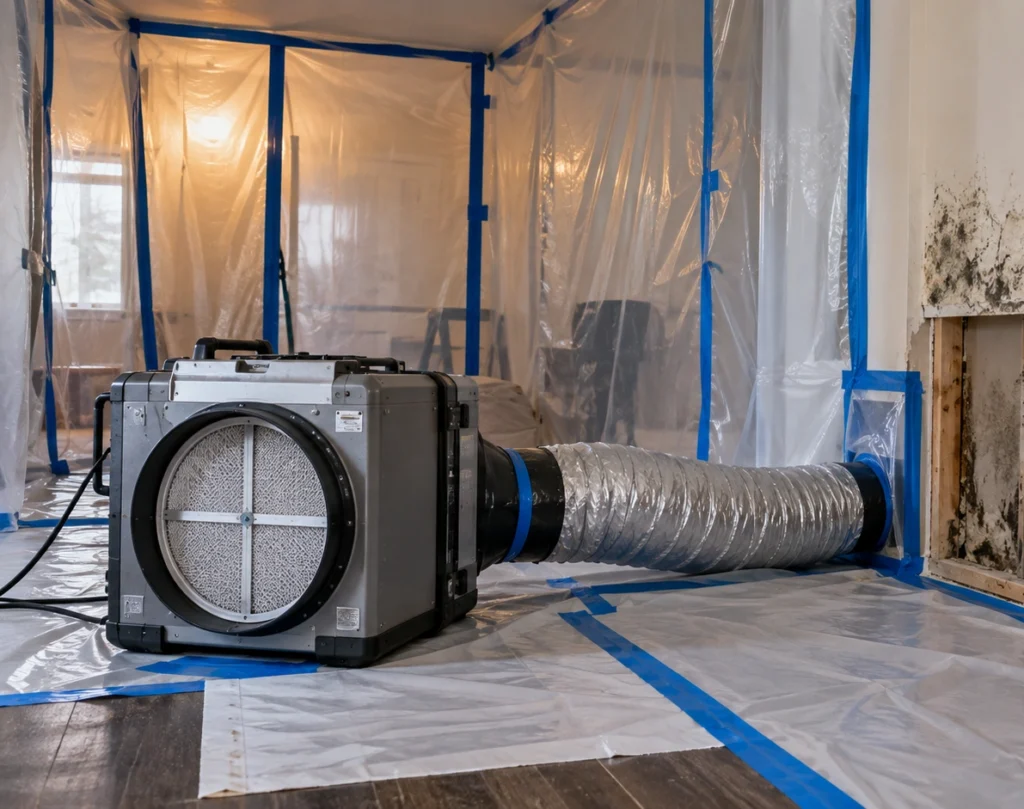
Before any mold removal begins, the affected area gets sealed off with plastic sheeting and negative air pressure, which keeps disturbed spores from spreading to unaffected parts of the home during the work. This step alone is something a spray-and-wipe approach skips entirely, and it is a major reason DIY attempts on anything beyond a small spot often make an existing problem worse by spreading spores into rooms that were previously clean.
Removal of Affected Porous Materials
Where a spray tries to kill mold in place, professional mold removal typically removes porous materials that mold has colonized, such as affected drywall, insulation, or carpet padding, rather than attempting to clean them. This is the step that actually eliminates the problem instead of masking it, since mold embedded in a porous material’s internal structure cannot be reliably killed without removing the material itself.
HEPA Vacuuming and Surface Cleaning
Non-porous surfaces within the containment area get HEPA-vacuumed and cleaned with antimicrobial solutions designed for remediation use, not consumer retail products. HEPA filtration captures spores down to a size that a standard vacuum or a spray bottle simply cannot address, which matters most for framing, subfloor, and other structural material that gets kept rather than removed.
Addressing the Moisture Source
None of the steps above hold if the moisture feeding the mold never gets fixed. Professional remediation identifies and addresses the underlying source, whether that is a slow plumbing leak, poor ventilation, or a roof issue, because removing mold without fixing what fed it just resets the timer on when it comes back.
Why Mold Removal Works Better Than Store-Bought Sprays, Side by Side
Factor | Store-Bought Spray | Professional Mold Removal |
Non-porous surfaces (tile, glass) | Effective for small, isolated spots | Effective, typically not needed for this alone |
Porous surfaces (drywall, wood) | Kills surface mold, roots often survive | Removes affected material entirely |
Spore containment | None, spraying can disturb and spread spores | Sealed containment with negative air pressure |
Moisture source | Not addressed | Identified and addressed as part of the job |
Recurrence risk | High if the root cause is not fixed separately | Low when moisture source is corrected |
The pattern across every row is the same: a spray addresses what is visible right now, while professional removal addresses what is causing it and what is hidden.
Where a Spray Is a Reasonable First Step
Being fair to the spray bottle: a small spot of surface mold on a non-porous, well-ventilated surface, caught early and with no history of recurrence, is a genuinely reasonable case for a consumer product. Not every spot of mold requires a remediation crew, and the EPA itself notes that small areas can often be handled without professional help when the affected surface is manageable and non-porous.
Where that reasoning breaks down is scale and material. An area larger than roughly ten square feet, mold on a porous material, a spot that keeps returning after cleaning, or any growth tied to hidden moisture behind a wall are all situations where a spray is treating a symptom rather than solving the underlying problem.
A Quick Way to Check Which Situation You Have
Before reaching for either option, a few quick checks help sort out which category a spot actually falls into. Press a gloved finger gently near the discoloration: if the surface feels soft, swollen, or damp, moisture has likely already worked its way into the material, and a spray is unlikely to solve anything long-term. Check whether the spot is growing on a hard, sealed surface or something absorbent like drywall, unsealed wood, or fabric, since that single distinction predicts most of the outcome. And think back on whether this exact spot has shown up before in the same location, since a repeat appearance almost always means the moisture source, not the mold itself, is the real unresolved problem.
None of these checks require special equipment, and none of them take more than a couple of minutes. They will not replace a professional inspection when the answer is genuinely unclear, but they are usually enough to tell a homeowner whether a fifteen-dollar spray is a reasonable next step or just a way to delay a call that is going to happen eventually anyway.
When a Spray Is Actively the Wrong Tool
A few situations turn a spray from a reasonable first step into a mistake:
- Mold on drywall, wood framing, insulation, or carpet padding rather than a hard, non-porous surface.
- A spot that has already returned once or twice after previous cleaning attempts.
- Any mold covering an area larger than about ten square feet.
- Black mold specifically, where the priority is confirming what is growing and addressing the moisture source rather than experimenting with retail products.
- Mold tied to a known or suspected leak that has not been fixed yet.
Any one of these is a reasonable point to stop reaching for a spray bottle and call a professional instead.
Why the Cost Comparison Is Not as Simple as It Looks
A spray bottle costs a fraction of a professional service call, and on paper that makes it look like the obvious choice. The real comparison is not spray price versus service price, though, it is spray price versus the cost of replacing drywall, flooring, or framing after a small spot goes unresolved for another year.
This math shows up most clearly with black mold removal specifically, since black mold tends to draw the most concern and the most impulse-buy spray purchases. A homeowner who spends fifteen dollars on a spray for a recurring black mold spot, watches it come back twice, then finally calls a professional has typically spent more time and often more money than someone who called for an inspection at the first sign of recurrence. The spray is not wrong to try once. It is the repeated attempts on the same spot that end up costing more than addressing the actual problem the first time.
How The Mold Guys Approaches Mold Removal
The team at The Mold Guys starts every removal job by confirming what is actually happening before recommending a full remediation process, since not every call needs the same scope of work. When professional mold removal is genuinely needed, the process includes proper containment, removal of affected porous materials, HEPA cleaning, and identifying the moisture source behind the growth, so the same spot does not just reappear a few months later.
The Right Tool Depends on What You Are Actually Treating
Professional mold removal works better than store-bought sprays specifically because it treats the whole problem: the visible growth, the material it has colonized, and the moisture feeding it, rather than just the surface layer a spray can reach. A spray has its place for small, isolated spots on the right kind of surface, but leaning on one for anything bigger usually just delays the real fix while the underlying moisture keeps doing damage.
If a spot keeps coming back or you are dealing with black mold, water damage, or growth on a porous material, The Mold Guys provides professional mold removal and mold inspection and testing across Southwest and Central Florida. With over 25 years of experience and certification through the I.I.C.R.C and I.I.A.Q.C, they know when a spray is enough and when it is not. Contact The Mold Guys today to get an honest answer.
Sources
U.S. Environmental Protection Agency, Mold Remediation in Schools and Commercial Buildings Guide: Chapter 3 (accessed 2026). U.S. federal environmental agency. Written for schools and commercial buildings. Supports these points: remediation areas are contained under negative pressure with polyethylene sheeting, HEPA vacuums are recommended for final cleanup, wet porous materials with mold growth may have to be discarded, it is necessary to clean up mold and not just kill it, and the water or moisture problem must be fixed or the mold may return.
U.S. Environmental Protection Agency, A Brief Guide to Mold, Moisture and Your Home (accessed 2026). U.S. federal environmental agency. Supports these points: moldy areas under about 10 square feet can usually be handled by the homeowner, mold can grow in the crevices of porous materials, and dead mold can still cause allergic reactions so it must be removed.
FAQs
Q: Is it true that mold removal works better than store-bought sprays?
A: Professional mold removal addresses the visible growth, the porous material it has colonized, and the moisture source feeding it, while a spray only kills what it touches on the surface. On porous materials like drywall or wood, the roots often survive a spray treatment and the mold returns.
Q: Can I use bleach spray to remove black mold myself?
A: Bleach can kill surface mold on hard, non-porous surfaces, but it struggles on porous materials because its water content soaks in and its chlorine breaks down before reaching mold embedded deeper in the material. For black mold specifically, confirming what is growing and addressing the moisture source matters more than the product used to clean the surface.
Q: When is a store-bought mold spray actually fine to use?
A: A spray is a reasonable first step for a small, isolated spot on a non-porous, well-ventilated surface with no history of returning. Once an area exceeds roughly ten square feet, involves a porous material, or keeps coming back, professional mold remediation is the more reliable option.
Q: Does professional mold removal include fixing the moisture problem?
A: Yes. Removing mold without addressing the leak, poor ventilation, or other moisture source feeding it typically means the growth returns. Professional mold removal identifies that source as part of the job, not as a separate, optional step.
Q: Why does mold keep coming back after I clean it with a spray?
A: If the mold has already colonized a porous material like drywall or wood, a surface spray often kills only the visible growth while roots survive beneath the surface. Unless the material is removed and the underlying moisture source is fixed, the same spot commonly reappears within weeks or months.