
Most homeowners think of water damage restoration as mopping up and running a few fans until things feel dry. Professional water damage restoration is a lot more structured than that, and the gap between the two is exactly where mold problems, warped flooring, and rotted framing tend to show up months later. A real restoration job is measured, documented, and verified before anyone calls it finished, not judged by whether the carpet feels dry to the touch.
That distinction matters most after the fact, when a homeowner is dealing with a musty smell six weeks later or an insurance adjuster asking for proof the drying was actually completed. A wet-vac and a box fan will not produce that proof. A documented restoration process will.
This guide walks through every stage of professional water damage restoration, the equipment involved, why moisture readings matter more than visual dryness, and what a completed job should include before you consider the work done.
What Professional Water Damage Restoration Actually Includes
A complete restoration job follows a set sequence: stopping and assessing the water intrusion, extracting standing water, structurally drying the affected materials, and verifying with instruments that the drying actually worked before anything gets closed back up or rebuilt.
Emergency Water Extraction
The first hours after water damage occur are the ones that decide how much of the job is cleanup versus reconstruction. Standing water gets removed with truck-mounted or portable extraction units, which pull far more volume, far faster, than a shop-vac or towels ever could. Speed matters here specifically because mold can begin colonizing damp material in as little as 24 to 48 hours, so the faster the standing water is gone, the smaller the affected area stays.
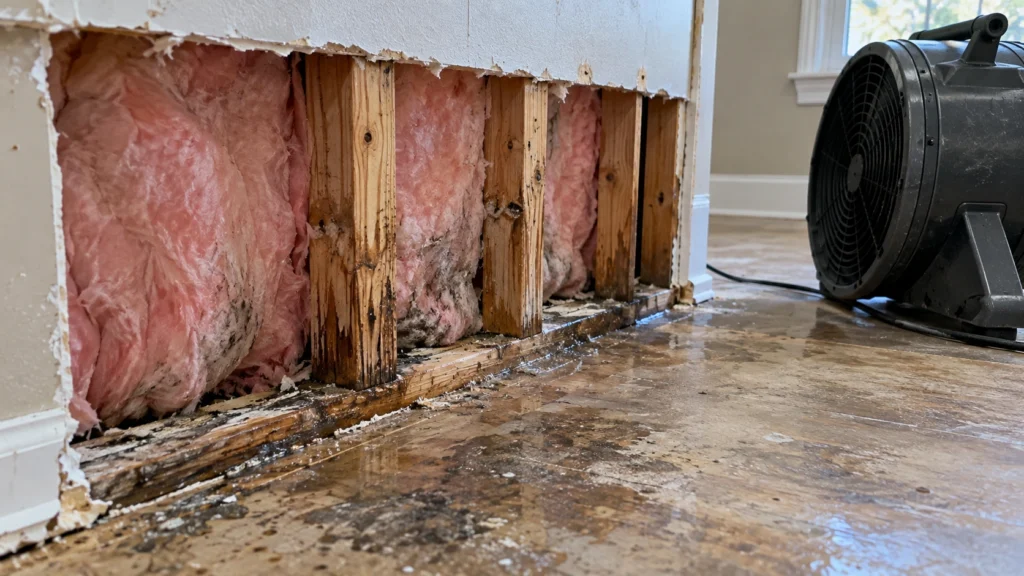
Once visible water is removed, the technician assesses what got wet and how badly: flooring, drywall, baseboards, subfloor, insulation, and any furniture or belongings caught in the affected area. This assessment is what determines whether a material can be dried in place or needs to be removed entirely, since some materials, like wet insulation or swollen particleboard, rarely recover even with aggressive drying.
Structural Drying and Dehumidification
This is the part of water damage restoration that separates a professional job from a DIY cleanup, and it is also the part most homeowners underestimate. Industrial air movers and dehumidifiers get positioned to pull moisture out of walls, subfloor, and framing, not just the visible surface. Drying a wall from the inside out takes days, not hours, which is why equipment often stays in place for three to five days depending on how saturated the materials were and how humid the environment is to begin with.
Moisture meters get used throughout this phase to track progress against the material’s dry standard, a documented benchmark for what “dry” actually means for that specific type of wood, drywall, or subfloor. Pulling equipment before materials hit that standard is one of the most common ways a water damage job goes wrong, since anything left even slightly damp inside a wall cavity becomes exactly the environment mold needs to take hold.
Moisture Mapping and Verification
Structural drying without measurement is just guessing with better equipment. Moisture mapping is what turns the drying process into something that can be verified, documented, and defended if a question ever comes up later.
How Moisture Is Tracked Throughout the Job
A technician takes moisture readings at the start of the job to establish a baseline, then continues taking readings at the same points throughout the drying process to track whether materials are actually trending toward dry. These readings get logged daily, creating a paper trail that shows exactly how the drying progressed rather than relying on a single end-of-job check.
Why the Dry Standard Matters More Than a Visual Check
A wall can look and feel dry on the surface while still holding excess moisture several layers deep, which is exactly why a visual or touch check is not reliable on its own. The dry standard accounts for the specific material and its normal moisture range in that climate, so a reading gets compared against an unaffected reference point in the same structure rather than an arbitrary number. Only once every monitored point in the affected area matches that standard does a job get called complete.
Equipment Used in Professional Water Damage Restoration
Equipment | What It Does | Why It Matters |
Truck-mounted extraction unit | Removes large volumes of standing water quickly | Limits how much material has time to absorb water before drying starts |
Industrial air movers | Circulates air across wet surfaces to speed evaporation | Pulls moisture out of flooring and walls, not just the surface layer |
Low-grain refrigerant dehumidifier | Removes moisture from the air itself | Keeps evaporated moisture from just resettling on nearby surfaces |
Moisture meter | Measures moisture content inside a material | Confirms progress against a documented dry standard, not a guess |
Thermal imaging camera | Identifies temperature differences that indicate trapped moisture | Finds damp spots behind walls and under flooring without demolition |
Each piece of equipment covers a different part of the process, and skipping any one of them is usually what turns a straightforward drying job into a mold problem a few weeks later.
Content Restoration and Insurance Documentation
Water damage restoration is not limited to the structure itself. Furniture, documents, electronics, and personal belongings caught in the affected area often need their own restoration process, and how that gets handled can be the difference between saving items and replacing them.
Salvageable items get cleaned, dried, and in some cases treated with antimicrobial solutions to prevent mold growth on porous materials like upholstery or wood furniture. Items that cannot reasonably be saved get documented with photos before disposal, since that documentation is exactly what an insurance claim needs to support a replacement cost.
Throughout the entire job, a professional water damage restoration provider should be logging moisture readings, photographing affected areas at each stage, and keeping equipment run-time records. That paper trail is what supports an insurance claim and gives a homeowner proof the job was actually completed to standard, not just declared finished.
How Long Water Damage Restoration Takes
A typical structural drying job takes three to five days once extraction is complete, though the exact timeline depends on how much water was involved, how porous the affected materials are, and how humid the surrounding environment is. A small, contained leak might dry in as little as two days, while a larger flood affecting multiple rooms or requiring extensive material removal can turn into a full flood damage restoration project taking a week or more before every reading matches the dry standard.
Homeowners working against an insurance deadline or a real estate closing should ask for a projected timeline upfront, along with an explanation of what could extend it, rather than assuming a fixed number of days applies to every situation.
Where Restoration Alone Is Not Enough
Water damage restoration and mold prevention overlap heavily, but they are not automatically the same job, and being upfront about that distinction matters. If mold growth is already visible when a restoration team arrives, drying the structure alone will not resolve it. Visible mold needs to be addressed directly, typically through a separate mold removal process, since drying wet material that already has active growth on it just leaves the mold in place on a now-dry surface.
The World Health Organization’s guidance on dampness and mold ties indoor moisture problems directly to respiratory symptoms and asthma risk, which is exactly why restoration and mold remediation are treated as connected but distinct steps rather than one job that automatically covers the other. A homeowner should ask directly whether visible mold was present at the time of the restoration and, if so, how it was handled.
Signs You Need Professional Water Damage Restoration Rather Than DIY Cleanup
A few situations make professional restoration worth calling rather than handling it with a wet-vac and box fans:
- Standing water that covers more than a small, contained area.
- Water that has been sitting for more than 24 hours before it was discovered.
- Water damage affecting flooring, drywall, or subfloor rather than just a spill on a hard surface.
- Any water event tied to a flood, burst pipe, or storm where insurance documentation will matter.
- A musty smell or visible warping that shows up after a leak that seemed minor at the time.
Any one of these is a reasonable reason to call a professional rather than spend days running fans and hoping the problem resolves on its own.
How The Mold Guys Handles Water Damage Restoration
The team at The Mold Guys treats every water damage call as the first step in preventing a future mold problem, not just a drying job to check off. That means moisture mapping and documented dry standards on every job, a direct conversation about whether mold remediation is also needed, and a paper trail that holds up if an insurance claim follows. Restoration and mold removal are handled as connected services specifically so a homeowner is not left managing two separate companies and two separate timelines.
A Documented Drying Process Protects You Later, Not Just Now
Professional water damage restoration is worth the cost specifically because it replaces a guess about dryness with verified, documented proof: moisture readings that hit the standard, equipment run for the right amount of time, and a paper trail that supports an insurance claim if one comes up. Skipping that process in favor of fans and a few dry-feeling days usually just delays finding out about hidden moisture until it has already turned into a mold problem.
If you are dealing with water damage and want a documented, verified drying process rather than a guess, The Mold Guys provides water damage restoration and mold removal across Southwest and Central Florida. With over 25 years of experience and certification through the I.I.C.R.C and I.I.A.Q.C, they know exactly what a restoration job needs to include before it is truly finished. Contact The Mold Guys today to schedule an assessment.
Sources
A Brief Guide to Mold, Moisture and Your Home, U.S. Environmental Protection Agency (accessed 2026). U.S. federal environmental agency. Supports these points: water-damaged areas and items should be dried within 24 to 48 hours to prevent mold growth.
WHO Guidelines for Indoor Air Quality: Dampness and Mould, World Health Organization (2009) International public health agency. Supports these points: there is sufficient evidence of an association between indoor dampness and respiratory health effects, including asthma, wheeze and cough.
FAQs
Q: What does professional water damage restoration actually include?
A: A complete service includes emergency water extraction, structural drying with industrial air movers and dehumidifiers, moisture mapping to track progress against a documented dry standard, content restoration for salvageable belongings, and detailed documentation to support any insurance claim.
Q: How is structural drying different from just running fans?
A: Structural drying uses industrial equipment positioned to pull moisture out of walls, subfloor, and framing, not just the visible surface, and progress is measured with moisture meters against a documented dry standard. Household fans move air across a surface but do not reach moisture trapped several layers deep inside a wall or floor, which is why professional water damage cleanup relies on measured drying instead of visual dryness.
Q: How long does water damage restoration take?
A: A typical structural drying job takes three to five days once extraction is complete, though larger floods or more porous materials can extend that timeline. Homeowners working against an insurance deadline or closing date should ask for a projected timeline and what could extend it.
Q: Does water damage restoration also remove mold?
A: Not automatically. Restoration focuses on extracting water and drying the structure to a verified standard. If mold growth is already visible, that needs to be addressed directly through a separate mold removal process, since drying a surface with active growth on it just leaves the mold in place.
Q: Can I use water damage restoration documentation for an insurance claim?
A: Yes, and that is one of the main reasons to hire a professional service rather than handling cleanup yourself. Logged moisture readings, dated photos, and equipment run-time records give an insurer objective proof the drying was completed to standard.