
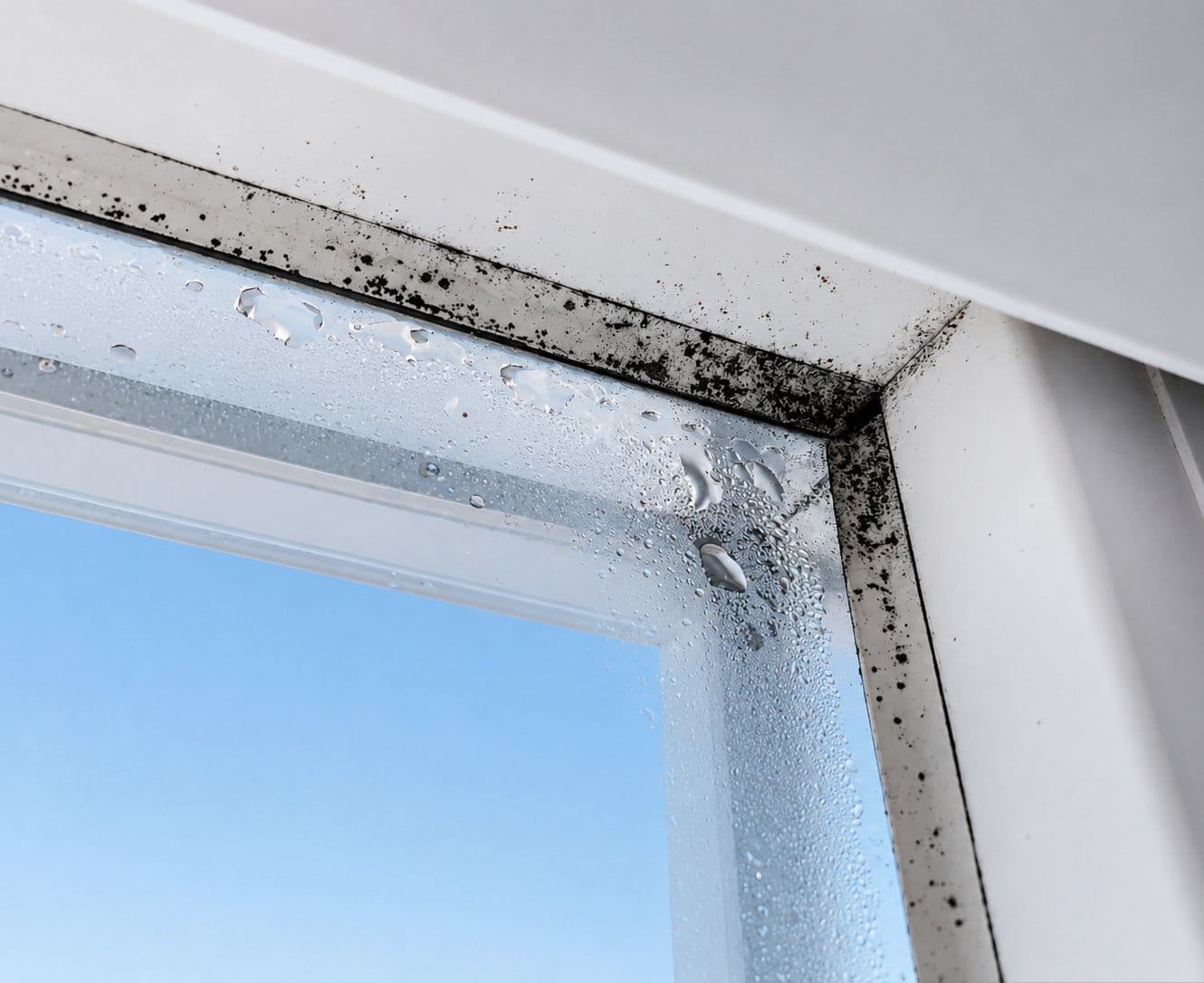
Windows are one of the most common locations for mold growth in the home, and also one of the most frequently misidentified. The dark marks that appear on window sills, frames, and tracks are sometimes dismissed as dirt or general grime and cleaned casually without addressing the conditions that caused them. Understanding what does mold looks like on windows allows you to identify the problem accurately, assess how serious it is, and respond in the way that actually stops it from returning rather than just temporarily removing what is visible.
The fastest answer is this, mold growing on windows most commonly appears as dark green, black, or gray patches or speckling on the sill, frame, track, or rubber seal, often accompanied by a musty smell and a surface texture ranging from fuzzy to slightly slimy depending on the species and how long it has been present. Once you know what you are looking at, the more important questions are why it is there, how far it may have spread, and what the right treatment approach is. We will cover all of it in this guide.
Why Windows Are Among the Most Common Places for Mold
Windows create a unique combination of conditions that make them reliably prone to mold growth. Understanding these conditions explains both why window mold is so common and why it tends to return in the same locations after cleaning if the root cause is not addressed.
Condensation Is Inevitable on Window Surfaces
Windows are the coldest interior surfaces in most homes, particularly single-pane windows or older double-pane units with failing seals. When warm humid indoor air contacts the cooler glass and frame surface, condensation forms. In Florida’s climate, where indoor air is consistently warm and the outdoor temperature differential during cooler months creates significant condensation events, this condensation is not occasional. It is a regular occurrence that keeps window sills and frames damp for extended periods.
Window Sills and Tracks Collect and Retain Moisture
The horizontal surfaces of window sills and the recessed channels of window tracks are designed to manage water and condensation but are not self-drying. Water that collects in these areas sits until it evaporates naturally, which in an enclosed room with limited airflow can take hours. During that time the moisture is in contact with the organic dust, pollen, and debris that naturally accumulates in these horizontal surfaces, providing both the moisture and the food source that mold needs to establish.
Rubber Seals and Caulk Lines Trap Moisture
The rubber gaskets that seal glass panes into frames and the caulk lines at the junction of frame and sill create narrow enclosed spaces that trap moisture and organic residue. These materials are semi-porous and provide both a food source and a protected habitat for mold spores. Mold established in a caulk line or rubber gasket is more difficult to eliminate completely than surface mold on hard materials because it can root into the material itself.
Failed Window Seals Allow Water Intrusion
When the weatherstripping, caulk, or flashing around a window fails, rainwater enters not just the window frame but the wall cavity surrounding it. Mold growing at the edges of a window frame, particularly at the corners or where the frame meets the interior wall surface, often indicates water intrusion from outside rather than simple condensation inside. This distinction matters significantly for treatment because condensation-driven mold can be addressed through humidity control and cleaning, while intrusion-driven mold requires both cleaning and repair of the failed seal.
What Does Mold Look Like on Windows: A Detailed Description
Mold on windows presents in several consistent visual forms that help identify both the type of mold present and how established the growth is.
Color and Appearance by Growth Stage
Stage | Appearance | What It Indicates |
Early growth | Small dark specks or light gray powdering on sill or track | Recent establishment, moisture source actively present |
Established growth | Black, dark green, or gray patches with fuzzy or velvety texture | Colony has been present for days to weeks |
Mature growth | Dense black or greenish-black coverage, possibly slimy when moist | Extended moisture exposure, deeper material penetration likely |
Dried inactive mold | Powdery dark residue that spreads when disturbed | Colony dried out temporarily but spores remain viable |
Mold in caulk or seal | Dark staining within the caulk bead or rubber seal that cannot be wiped away | Growth penetrating into the material, surface cleaning insufficient |
Black Mold on Windows
The most concerning appearance is dense dark greenish-black growth that looks slightly slimy or wet when the surface is moist and becomes powdery when it dries. While appearance alone cannot confirm Stachybotrys chartarum without laboratory testing, any growth matching this description on a window surface that has had persistent moisture should be treated with caution and assessed professionally. Our guide on how to test for toxic black mold covers both DIY and professional testing options for confirming species.
White or Gray Mold on Windows
White or light gray powdery growth on window sills and frames is commonly one of the more benign species such as Aspergillus or Penicillium. While less immediately alarming in appearance than black growth, these species still produce airborne spores that cause respiratory irritation and allergic reactions with regular exposure and should be cleaned and the moisture source addressed promptly.
Mold vs. Dirt: How to Tell the Difference
A common source of confusion is distinguishing mold growing on windows from accumulated dirt or staining. These differences help you identify which you are looking at.
Mold typically appears in irregular organic-looking patches that spread outward from a central point. It often has a slightly fuzzy or textured surface. It produces a distinct musty odor when disturbed. It resists removal with dry wiping and returns in the same location after cleaning if the moisture source remains.
Dirt or mineral deposits typically accumulate in linear patterns following water flow paths or settle evenly across surfaces. They do not have a fuzzy texture. They produce no odor when disturbed. They are removed with wiping and do not return in the same pattern unless new deposits form.
If you are unsure which you are looking at, apply a small amount of white vinegar to the area and watch for a reaction. Mold typically darkens or the surface becomes slightly more visible as the vinegar penetrates. Dirt and mineral deposits do not react in this way.
Where to Look for Mold Growing on Windows
Mold growing on windows does not always appear in the most obvious location. A thorough inspection covers these specific areas.
The Window Sill
The horizontal surface below the glass is the most common location for window mold because it receives the most condensation drip and holds moisture the longest. Inspect the entire sill surface including any painted wood or painted drywall sections along the sill, the corner junctions where the sill meets the wall on each side, and the underside of the sill overhang if it is accessible.
The Window Track
The recessed channels that the window slides within accumulate organic debris and moisture consistently. Mold in window tracks often appears as dark growth along the bottom of the channel, at the corners of the track where debris collects, and on the track surface directly beneath the weep holes that are designed to drain collected water.
The Frame and Glazing Bead
The vertical and horizontal frame members and the plastic or rubber glazing bead that holds the glass pane in place are vulnerable to mold at their junction points. Look for dark discoloration at the corners of the frame where moisture tends to collect and at the bead-to-glass interface where a small gap can trap water and debris.
The Rubber Gasket and Weatherstripping
Run your finger along the rubber seal around the glass pane and along the weatherstripping that compresses when the window closes. Dark staining that is part of the material rather than on the surface, or that cannot be removed by wiping, indicates mold that has penetrated into the rubber material itself.
The Interior Wall Surface Adjacent to the Frame
Inspect the wall surface on all sides of the window frame, particularly the lower corners and the sill-to-wall junction. Mold or staining on the adjacent wall rather than on the window frame itself indicates water intrusion from outside the window rather than condensation inside, a more significant finding that suggests seal failure.
When Window Mold Is a Minor Problem vs. When to Worry
Not every instance of mold growing on windows represents the same level of concern. These factors help you assess severity.
Minor Concern
Surface mold limited to the sill or track with no penetration into the frame material, in a home with otherwise good humidity control and no history of window seal failure, is a manageable situation that responds well to thorough cleaning and humidity reduction. This scenario typically involves a single window with high localized condensation, such as one that faces a regularly used cooking area or bathroom.
Moderate Concern
Mold that has penetrated into caulk lines, painted wood sills, or the rubber gasket and cannot be removed by surface cleaning requires more thorough treatment. Mold staining in these materials indicates the growth has worked below the surface where surface-level cleaning leaves active spores. The caulk or seal may need to be fully removed and replaced as part of treatment, and the moisture source driving the condensation needs to be addressed to prevent rapid recurrence.
Significant Concern
Mold appearing on the wall surface adjacent to the window frame rather than on the frame itself, mold at multiple windows throughout the home, mold returning rapidly after thorough cleaning, or a musty odor coming from around a window frame rather than from its surface all indicate conditions that go beyond simple window cleaning. These signs point to either widespread humidity problems throughout the home, window seal failures introducing water from outside, or mold having spread from the window area into the surrounding wall cavity.
At this level, professional mold removal is the appropriate response. A professional mold inspection determines whether the problem is contained to the window area or has spread into the wall structure, and professional treatment addresses the full extent of growth rather than only the visible surface.
When Window Mold Needs Professional Attention
Many homeowners assume window mold is a minor surface issue that can be wiped away and forgotten. In some very early-stage cases limited to a small patch of hard glass or uncoated vinyl, a basic cleaning may temporarily remove what is visible. But the problem with stopping there is that visible window mold is rarely the full extent of what is present.
By the time mold is noticeable on a window sill, track, or frame, it has typically been growing long enough to penetrate caulk lines, rubber gaskets, and the wood or composite materials beneath the painted surface. Removing the visible growth without addressing the depth of penetration and the moisture source sustaining it simply takes away the surface layer while leaving an active colony in place beneath it. The same patch returns within weeks, often larger than before, because the conditions driving it have not changed.
What Surface Cleaning Cannot Reach
The limitation of any surface cleaning approach on window mold is that it addresses only what is visible on the outermost layer of the affected material. Mold that has penetrated into caulk lines, rubber door seals, painted wood sills, or the composite material of window frames is growing below the surface that any wipe-down or spray treatment contacts. The portion of the colony at or above the surface is disturbed and removed. The portion rooted into the material below the surface continues growing and recolonizes the treated surface within days to weeks.
This is why window mold that keeps coming back in the same location despite repeated cleaning is not a cleaning technique problem. It is a depth-of-penetration problem that surface treatment cannot resolve. The material itself has been colonized and requires either professional treatment that goes below the surface or in the case of caulk and gasket materials, complete removal and replacement of the affected components alongside treatment of the surface beneath them.
When the Window Is Not the Only Problem
The more serious finding in window mold situations is when the growth has moved beyond the window frame itself into the adjacent wall cavity. This happens when window seal failure has been allowing rain water entry into the surrounding wall assembly rather than simple condensation on the interior window surface. In these cases the visible mold on the window frame is the surface indicator of a larger problem growing inside the wall behind and around the window opening.
Professional window mold removal in these situations involves assessing not just the window frame but the full wall assembly around it. A professional mold inspection using moisture meters and thermal imaging identifies whether the moisture and mold problem is contained to the window components or has spread into wall framing, insulation, and drywall that requires more extensive remediation alongside the window treatment.
What Professional Window Mold Removal Involves
Professional mold removal for window mold addresses the problem at its full depth rather than at its visible surface. This includes identifying the specific moisture source driving growth whether that is indoor humidity condensation, a failed window seal, or water intrusion from the surrounding wall assembly, and confirming that source is resolved as part of the treatment rather than leaving it in place to produce the same result again.
Affected caulk lines and gasket materials that cannot be cleaned effectively are removed completely. The underlying surfaces are treated with commercial-grade antimicrobial products and confirmed dry before new mold-resistant caulk and sealing materials are applied. Where wall cavity involvement is confirmed, containment is established before any wall work begins to prevent spore migration throughout the home during treatment.
Post-treatment verification confirms that the treated area is free of active growth and that moisture levels in surrounding materials have returned to safe ranges before the work is considered complete.
Preventing Mold from Returning on Windows
Cleaning removes existing growth. Preventing return requires addressing the moisture conditions that allowed mold to establish.
Reduce Condensation Through Ventilation and Humidity Control
The most direct way to reduce window condensation is to lower indoor humidity levels below 50 percent through consistent air conditioning and supplemental dehumidification. In rooms where condensation is particularly persistent, a small portable dehumidifier maintains localized humidity at levels where condensation on cooler window surfaces is significantly reduced.
Run bathroom exhaust fans during and for at least 20 minutes after showers. Run kitchen range hoods during cooking. These activities introduce large amounts of moisture into indoor air that then condenses on cooler surfaces throughout the home including window glass and frames.
Wipe Window Sills After Condensation Events
This single daily habit takes less than a minute and eliminates the standing moisture that supports mold establishment on sills and tracks. Keep a microfiber cloth near any window that regularly develops condensation and wipe the sill and track after high-humidity periods or after condensation is visible on the glass.
Inspect and Maintain Window Seals
Check window caulking and weatherstripping annually for any cracking, separation, or gaps that would allow rain water entry. Reapply caulk where the existing seal shows any deterioration. Check that window weep holes in the track channel are clear and allowing drainage rather than being blocked by debris.
Improve Airflow Around Windows
Where possible, position furniture away from window walls to allow air to circulate along the wall surface near windows. Stagnant air near cooler window surfaces creates localized humidity accumulation that supports mold in those specific areas even when general room humidity is within acceptable ranges.
When Professional Mold Removal Is the Right Call
Window mold that has spread beyond the window frame itself, that returns within weeks of thorough cleaning despite humidity control, or that appears at multiple windows simultaneously warrants professional mold removal rather than continued DIY treatment.
A professional mold inspection is particularly important when mold is appearing at window frames on exterior walls and the adjacent wall surface shows any staining, soft spots, or paint changes. These signs together indicate water intrusion from outside that has introduced moisture into the wall cavity around the window, where mold may be significantly more extensive than the visible window frame growth suggests.
Professional window mold removal as part of a broader remediation also addresses any growth that has spread from the window into the wall cavity, which surface cleaning of the visible window frame cannot reach or treat.
Final Thoughts
Knowing what does mold look like on windows removes the guesswork from one of the most common household mold situations. Dark speckling, fuzzy patches, and discolored caulk lines on window surfaces are reliable visual indicators of mold growing on windows, and a musty odor at the window area is an early sign of growth even before it becomes clearly visible.
Surface cleaning with vinegar or hydrogen peroxide addresses early-stage growth on hard surfaces effectively. Mold in caulk or gasket materials requires replacement of those components rather than cleaning. And mold that has moved from the window surface into the adjacent wall cavity requires professional mold removal with containment and post-treatment verification.
The consistent thread across all of these scenarios is addressing the moisture source first. Without reducing the condensation or water intrusion that created the growing conditions, any window mold treatment produces only a temporary result.
The team at The Mold Guys serves homeowners across Southwest and Central Florida with professional mold inspection, window mold removal, and mold removal services tailored to the specific moisture challenges Florida’s climate creates. With over 25 years of experience they understand why mold keeps coming back in Florida homes and how to resolve it completely. Contact The Mold Guys today for professional assessment whenever window mold goes beyond what surface cleaning can address.
FAQs
Q: Is mold on windows dangerous to my health?
A: Yes. Mold growing on windows releases spores into nearby indoor air continuously. In an enclosed room, these spores reach concentrations that cause respiratory irritation, allergy symptoms, and worsening asthma with regular exposure. Black mold species on windows additionally produce mycotoxins that cause more serious health effects with prolonged inhalation.
Q: Why does mold keep coming back on my windows after I clean it?
A: Recurring window mold means the moisture source creating growth conditions has not been resolved. Common causes include persistent condensation from high indoor humidity, inadequate ventilation in the room, failed window seals allowing rain water entry, or caulk that was surface-cleaned rather than replaced. Addressing the moisture source is what stops recurrence.
Q: Can I use bleach to clean mold off window frames?
A: Bleach is not recommended on painted wood or rubber window components as it damages these materials over time. It is effective on nonporous hard surfaces like uncoated metal or vinyl but evaporates before penetrating into semi-porous materials. White vinegar followed by hydrogen peroxide is safer and more effective for most window surfaces and materials.
Q: How do I know if the mold on my window frame has spread into the wall?
A: Signs that window mold has spread into the adjacent wall include staining or paint changes on the wall surface beside the window frame, a musty odor appearing to come from the wall rather than the window surface itself, and soft or spongy drywall near the window corners. A professional mold inspection with moisture meters confirms wall cavity involvement without destructive wall opening.
Q: Is it normal to have some mold on windows in Florida?
A: Florida’s high humidity makes window condensation and surface mold more common than in drier climates, but normal does not mean acceptable. Even small amounts of mold growing on windows release spores into indoor air. Consistent humidity control below 50 percent, regular sill wiping, and annual seal maintenance prevent the mold that Florida’s climate makes easy to develop.